Ukraine Strikes Kerch Bridge Ahead of High Profile Summit
A multi week campaign culminated in the damage of a critical Russian supply route, signaling Kyiv's continued strategic capability as world leaders prepare to meet.
By Luca Fernandez ·
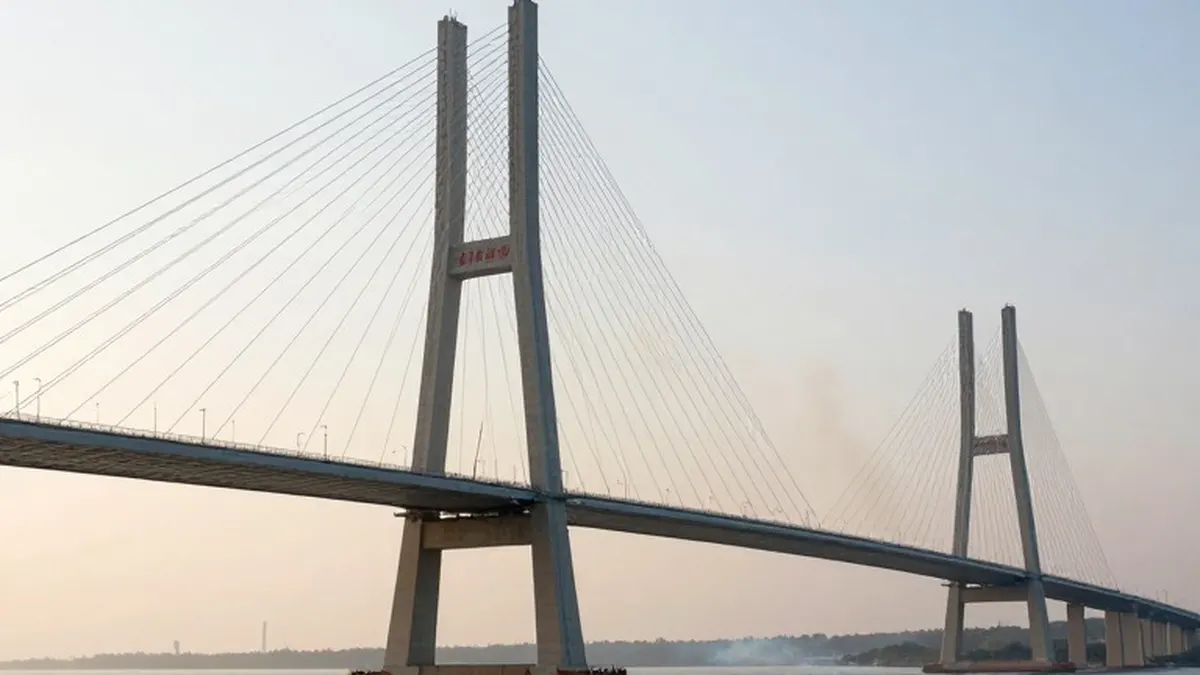
Ukraine’s overnight attack on the Kerch road bridge marks the culmination of extensive military operations and years of industrial development. During this period, Kyiv successfully developed its own cruise missiles and long range drones, enabling a level of precision that was previously unavailable.
The damage to the bridge is significant, though not total, as the adjacent rail bridge remains standing with one line still in operation. The collapse of a roadway span and its supporting arch represents a level of destruction that, according to Ben Hodges, a former commanding general of the US army in Europe, cannot be repaired any time soon.
This infrastructure is deeply symbolic for Russia. The 19km road bridge, valued at $3.6 billion, was completed in 2018 and closely associated with Vladimir Putin’s efforts to secure the 2014 annexation of Crimea. Putin was famously filmed driving an orange truck across the structure upon its completion, a moment highlighted by Kremlin spokesperson Dmitry Peskov as a personal initiative by the Russian leader.
The timing of the strike is notable, occurring two days before Putin is scheduled to meet Donald Trump and Xi Jinping in Shenzhen. For much of the war, Ukraine lacked the long range western missiles necessary to hit such a politically sensitive target. Early attempts, including a truck bomb in 2022 and a sea drone attack in 2023, failed to inflict lasting damage. It was only near the beginning of 2026 that Ukraine’s indigenous long range systems matured enough to make a decisive strike possible.
President Volodymyr Zelenskyy confirmed on Tuesday that the final phase of the operation involved Ukrainian made Neptune and Flamingo FP 5 cruise missiles, Palianytsia rocket drones, and Ruta cruise missiles from Dutch manufacturer Destinus. He described the event as the seventh stage of a multi week operation during which radars, jamming equipment, and air defense systems were progressively neutralized.
The strike occurs amidst a broader escalation in what is becoming a battle of the bridges. Moscow has recently targeted Kyiv’s Northern and Southern bridges as part of a campaign to disrupt the capital’s infrastructure. With Russia struggling on the frontline and reporting record troop casualties, its efforts to cut off electricity and water supplies have expanded to include key transport links.
Military analysts suggest that Ukraine now possesses a parity in firepower. The pro war Russian blogger Military Informant noted that the destruction of the road bridge in two days of air raids demonstrates this balance. There is speculation that the railway section may be targeted next to fully sever the link.
If the rail and road connections are both cut, Moscow would rely on the R 280 land highway from Rostov to Crimea, a route already subject to months of Ukrainian drone attacks. Hodges argues that making the occupation of Crimea untenable could be a defining strategy of the war, helping to break the narrative of inevitable Russian victory.
While the physical supply squeeze will take time to fully impact the front lines, the political benefits may be immediate. Emily Ferris, a Russia expert at the Rusi thinktank, noted that Ukraine’s military industrial complex has been ready for months. She suggested that the timing of the attack is purely political, stating that Ukraine was keeping this capability for a rainy day, and that day has now arrived.
The strike serves as a reminder to Trump, Putin, and Xi that Ukraine retains significant strategic cards to play, even as they seek to negotiate an end to the deadlocked conflict in Shenzhen.