Nigeria's Education Gap: Millions of Children Miss Out on Schooling
Nigeria faces a significant education gap with nearly 19 million children out of school, prompting the BBC World Service to launch a new Hausa-language learning program.
By Andres Henderson ·
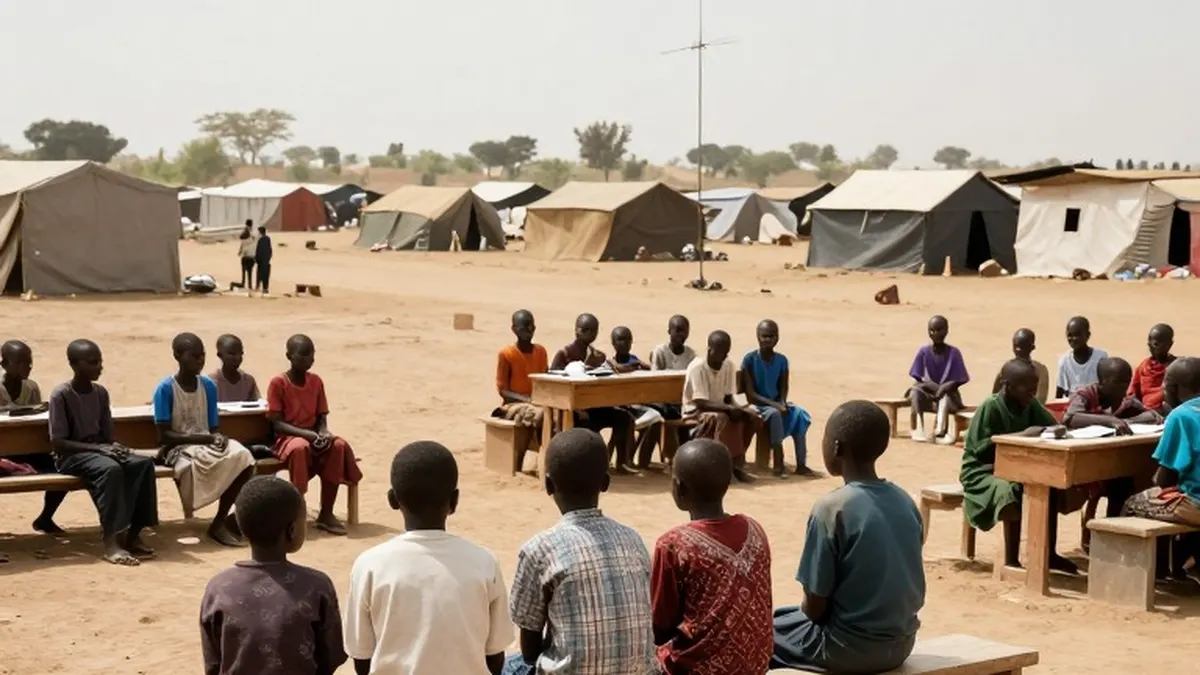
In a displaced persons camp in Goronyo, 15-year-old Hadiza sings the English alphabet while pounding millet. The song serves as a poignant reminder of the classroom she misses. She describes practicing her handwriting on the ground to ensure she has not forgotten how to write. Two years ago, armed men raided her village, driving away their cattle and abducting a girl. The family fled barefoot to the camp, where Hadiza attended school for a short period before marrying at age 13. She notes that local tradition often dictates that a girl's education ends upon marriage, despite Nigerian law prohibiting unions under the age of 18.
Hadiza is one of nearly 19 million children in Nigeria who are currently out of school, according to 2024 estimates from Unesco. This figure represents approximately one in four school-age children in the country. In response to this widespread challenge, the BBC World Service has launched Dars Hausa, an educational program designed for children in northern Nigeria and neighboring West African nations. The initiative delivers lessons in English, mathematics, and science through radio, social media, and local television partnerships. Radio remains a vital source of information in the region, with nearly half of Nigerian households owning a receiver, according to the charity Save the Children.
The name Dars means lesson in Pashto and Dari. The program originally launched in 2023 for Afghan children who were barred from attending school. An Arabic version was introduced in February 2025. The current Hausa edition aims to reach a broader audience across West Africa, where educational access is often limited by conflict and poverty.
The causes of the education crisis are complex. Rukayya, a 12-year-old also living in the Goronyo camp, expresses pain at seeing other children attend school while she cannot. As the eldest child, she spends her days gathering firewood to sell and begging for food for her younger siblings. Her father was killed by bandits a year ago, forcing the family to flee their home. She endures mockery from others but continues her work because it is their only means of survival.
Rukayya and Hadiza are part of a group of 670,000 people in north-west and central Nigeria who have been displaced by armed robbery and kidnappings, according to the International Organization for Migration. While some attacks are carried out by militant Islamist groups, the majority in this region are conducted by criminal gangs known as bandits. These groups engage in stealing, killing, and kidnapping, creating an environment of fear that affects daily life and education.
The only school serving children in the Goronyo camp typically has about 50 students per class. Kamilu Sulaiman Jakada, a teacher at the school, explains that despite lessons being free, attendance is sporadic. Parents often withdraw their children because the kids are needed to earn money for food. The school also suffers from a lack of teachers and classrooms, with funding often coming from individuals or organizations rather than consistent government support.
Security concerns further complicate attendance. A gang once arrived at the school on motorbikes, shooting in the air. Although no one was hurt, many parents became frightened and pulled their children out. This reaction to attacks is common in other parts of the country as well. Nigerian law mandates nine years of free, compulsory education, divided between primary and secondary levels. However, responsibility is shared among federal, state, and local governments, and many schools face shortages that make it difficult for poorer families to afford uniforms, books, and transport.
The crisis has developed over decades due to chronic underfunding and poor oversight. Additionally, children in the traditional Almajiri system, which focuses on Islamic education, are often not taught subjects like mathematics and science. Unicef considers these children to be out of school. Professor Suwaiba Sa'id, the Minister of State for Education, believes the number of out-of-school children may be lower than reported but admits that proper investment and oversight have been lacking. She noted that two states did not recruit a single teacher for eight years.
The government considers education its top priority. Initiatives such as Lumina aim to support one million girls by 2030 through accelerated learning programs for older students who have missed years of formal education. The minister also stated that the government is doing everything possible to deal with bandits, noting that some children who should be in school are instead engaged in banditry.
Hadiza still dreams of becoming a doctor to help other women. The Dars Hausa program aims to help children like her and Rukayya continue their education. The show will air on BBC News Hausa radio on Sundays at 06:45 West Africa Time, with a repeat at 20:45. It will also be available on digital platforms including YouTube, Facebook, X, and Instagram.